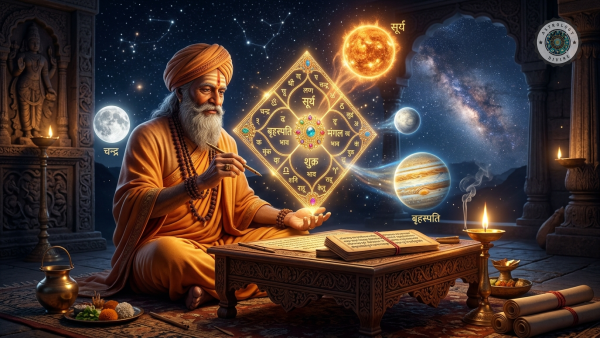
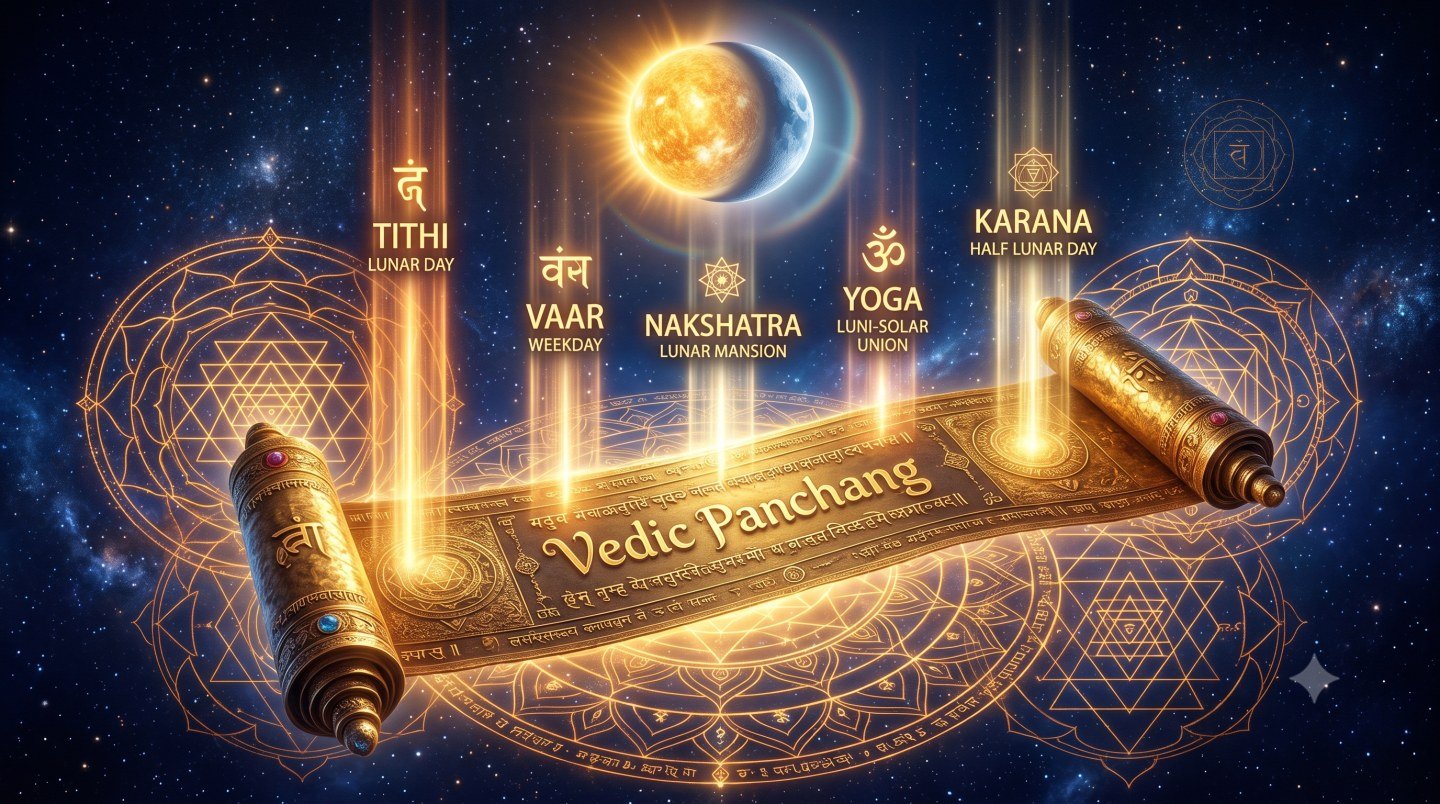
For thousands of years, Indian astronomers and Vedic sages used an exceptionally sophisticated astronomical calendar known as the Panchang (Panchanga). Derived from the Sanskrit words Pancha (Five) and Anga (Limbs), the Panchang represents the five-dimensional blueprint of cosmic time that synchronizes human actions with solar and lunar rhythms.
Whether you are looking for an auspicious date for marriage, planning a new business venture, fasting on sacred Ekadashi, or simply seeking daily clarity, reading the Panchang provides direct insight into the prevailing planetary currents.
Why Did the Ancient Rishis Create the Panchang?
Unlike Western Gregorian calendars which measure only the linear progression of solar days, the Vedic Panchang is a multidimensional astronomical almanac. It tracks the precise angular relationship between the Sun (representing the Soul, Vitality, and Life Force) and the Moon (representing the Mind, Emotions, and Consciousness).
By aligning human decisions with the favorable geometric angles of the cosmos, one minimizes natural friction, overcomes karmic impediments, and maximizes prosperity.
The 5 Vital Limbs (Pancha-Angas) Explained
1. Tithi (The Lunar Day)
Measures the 12° angular distance between the Sun and Moon. Dictates emotional receptivity, vitality, and suitable fasting or celebration days.
2. Vaar (The Solar Day)
The 7 days of the week ruled by the 7 classical planets (Sunday to Saturday), governing physical strength and daily temperaments.
3. Nakshatra (The Lunar Mansion)
The 27 star constellations dividing the 360° zodiac into 13°20' segments, transmitting specific cosmic frequencies and life karma.
4. Yoga (The Angular Sum)
The mathematical addition of the Sun and Moon’s longitudes into 27 Yogas, determining the purity and fortune of overall circumstances.
5. Karana (Half of a Tithi)
One half of a Tithi (6° distance). There are 11 Karanas in total, indicating the immediate outcome and success rate of specific actions.
Limb 1: Tithi (The 30 Lunar Phases)
A lunar month is split into two distinct fortnights (Pakshas):
- Shukla Paksha (Waxing Bright Half): From Pratipada (1st day) to Purnima (Full Moon). Ideal for starting projects, investments, expansion, and celebrations.
- Krishna Paksha (Waning Dark Half): From Pratipada to Amavasya (New Moon). Ideal for introspection, detox, ending negative habits, and ancestor rituals (Shraddha).
The 15 Tithis are further categorized into 5 functional archetypes (Pancha Mahatithi):
- Nanda (1, 6, 11): Yields delight, joy, celebrations, and festive beginnings.
- Bhadra (2, 7, 12): Favorable for business agreements, starting construction, vehicles, and education.
- Jaya (3, 8, 13): Overcoming competitors, legal victories, sports, and courage.
- Rikta (4, 9, 14): Literally "Empty". Inauspicious for auspicious milestones, but potent for defensive actions and removing negativity.
- Poorna (5, 10, 15/30): Complete fulfillment. Ideal for spiritual ceremonies, donations, and major life investments.
Limb 2: Vaar (The 7 Days and Their Governors)
Each day of the week carries the distinctive elemental energy of its planetary lord:
- Ravivara (Sunday - Sun): Leadership, public administration, gold purchase, spiritual initiation.
- Somavara (Monday - Moon): Maternal care, travel, water-related business, peace of mind, artistic works.
- Mangalavara (Tuesday - Mars): Courage, physical fitness, surgical procedures, real estate, engineering.
- Budhavara (Wednesday - Mercury): Accounting, coding, communication, business marketing, learning mathematics.
- Guruvara (Thursday - Jupiter): Education, temple worship, astrology, big financial investments, marriage consultations.
- Shukravara (Friday - Venus): Arts, design, luxury purchases, music, romance, jewelry shopping.
- Shanivara (Saturday - Saturn): Labor management, oil/mining, charity to the underprivileged, long-term discipline.
Limb 3: Nakshatra (The 27 Cosmic Constellations)
The Moon travels through one Nakshatra every approximately 24 hours. The active Nakshatra sets the psychological tone of the world on that day. For example:
- Pushya Nakshatra (The Nourisher): Revered as the king of all Nakshatras for buying gold, starting a business, and religious rites.
- Rohini & Revati: Highly fertile, creative, and peaceful for travel, marriage, and artistic pursuits.
- Mula & Ardra: Intense, transformational; suited for research, surgery, and dismantling obstacles rather than celebrations.
Limb 4: Yoga (The 27 Cosmic Combinations)
There are 27 Nitya Yogas. Among them:
- Highly Auspicious Yogas: Siddhi, Sadhya, Shubha, Shukla, Brahma, Indra, Ayushman, Saubhagya. Undertakings begun under these Yogas enjoy natural blessing and longevity.
- Inauspicious Yogas to Avoid: Vishkambha, Atiganda, Shoola, Ganda, Vyaghata, Vajra, Vyatipata, Parigha, Vaidhriti. Avoid crucial financial, marital, or surgical beginnings during these hours.
Limb 5: Karana (The 11 Action Outcomes)
Because every Tithi has two Karanas, a month comprises 60 Karanas categorized into:
- 7 Movable (Chara) Karanas: Bava, Balava, Kaulava, Taitila, Gara, Vanija, Vishti (Bhadra). Note: Vishti (Bhadra) is strictly avoided for all auspicious works like marriage and housewarming.
- 4 Fixed (Sthira) Karanas: Shakuni, Chatushpada, Naga, Kimstughna. Occur during the end of Krishna Paksha and are dedicated to ancestral rites and esoteric disciplines.
How to Read Today's Panchang in 3 Simple Steps
The Quick Daily Checklist:
- Check Tithi & Paksha: Ensure it is not a Rikta Tithi (Chaturthi, Navami, Chaturdashi) or Vishti (Bhadra) Karana for major milestone tasks.
- Verify Auspicious Periods: Look for Abhijit Muhurat (mid-day golden window), Brahma Muhurta (early morning spiritual window), and Sarvartha Siddhi Yoga.
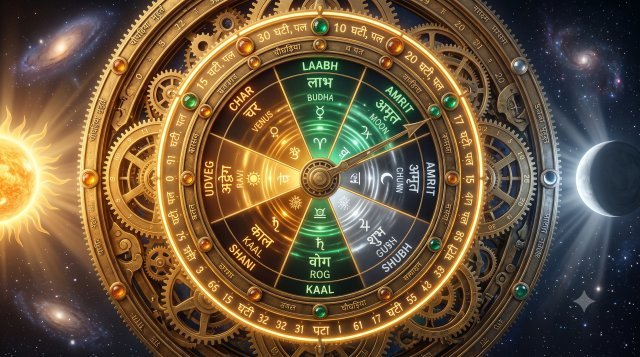
- Check Inauspicious Periods: Mark the exact local timings for Rahu Kaal, Yamaghanta, and Durmuhurta to ensure your vital meetings are scheduled safely outside these blocks.
Frequently Asked Questions About Panchang (FAQs)
What is the difference between Amanta and Purnimanta Panchang?
Both follow the same lunar tithis, but differ in when the month concludes. In the Purnimanta system (predominant in North India), the month ends on Purnima (Full Moon). In the Amanta system (predominant in South India, Gujarat, and Maharashtra), the month ends on Amavasya (New Moon).
What is Abhijit Muhurat in Daily Panchang?
Abhijit Muhurat is the 8th Muhurta of the day occurring roughly 24 minutes before and after local astronomical noon. It is blessed by Lord Vishnu and possesses the power to eliminate countless minor astrological afflictions, making it ideal for immediate auspicious tasks.
Why is Bhadra (Vishti Karana) considered inauspicious?
Bhadra is the daughter of Sun God Surya and sister of Lord Shani. Mythologically and astronomically, her energy is turbulent and destructive. Therefore, auspicious ceremonies like weddings, naming rites, Griha Pravesh, and Raksha Bandhan are forbidden during Bhadra.
How can I check today's accurate Panchang online?
You can check today's complete Panchang for any location worldwide on Astrology Divine’s high-precision Daily Panchang calculator, which computes real-time tithi, nakshatra, yoga, karana, sunrise/sunset, and planetary transitions.